
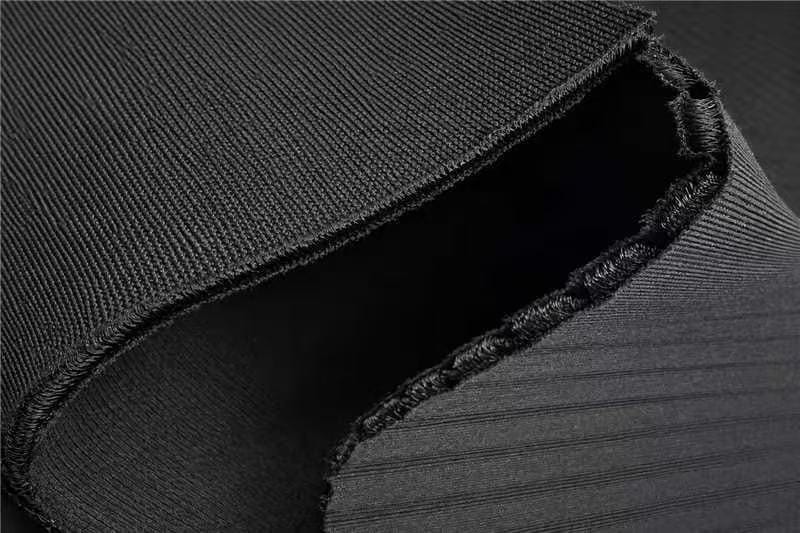
In performance knee brace and dynamic support development, engineering teams frequently encounter a puzzling prototyping hurdle: a spacer fabric can pass every bench test for tensile stretch and static compression, yet still fail to conform smoothly during dynamic movement.
When worn on an articulating joint, the material buckles, bunches at the crease, or lifts away from the skin, leaving hollow gaps. In short: it stretches out, it cushions down, but it refuses to bend cleanly. This can involve bending, stretching and local deformation.
AG505 explores this part of the design. Developed as a customized version of AG504-2, it uses regularly separated groups of spacer monofilaments to form channels within the middle layer. Its specifications are 415 GSM and 142 cm wide. The same questions about conformability and internal airflow also make this structure worth evaluating for other braces, supports and wearable padding.
Stretch, Bending Flexibility and Conformability
When selecting a brace fabric, it helps to consider three properties separately:
| Material property | What it describes | What developers can evaluate |
|---|---|---|
| Stretch and recovery | How the fabric extends and returns after release | Accommodation of dimensional changes |
| Bending flexibility | How readily the fabric curves | Its ability to follow the intended shape |
| Compression behavior | How its thickness changes under load | Cushioning feel and support under pressure |
When a knee flexes from 0° to 90°+, the outer face of the brace elongates while the inner face undergoes acute compression and tight-radius bending. In a conventional, uniformly filled spacer fabric, the intermediate monofilaments have nowhere to displace under bending compression. Instead, they crowd together, resist the bend, and force the fabric outward—creating sharp pleats, skin pinch points, and loss of surface contact.
Adding more spandex to the face fabric does not resolve this internal mechanical interference; the spacer core itself must provide geometric relief.
Our earlier introduction to AG504-2 and A9912 for medical braces and wheelchair upholstery discusses the role of spacer construction and elastic materials. AG505 takes that discussion further by focusing on how the middle layer is organized.
What Changes Inside AG505?
AG505 retains a three-dimensional construction with two fabric faces connected by spacer monofilaments. Its distinguishing feature is the regular separation of those monofilaments into supporting regions, with channel spaces between them.
Monofilament Support Ribs: Densely arranged vertical/angled monofilament clusters that preserve load-bearing capacity, impact dampening, and thickness retention under extension.
Intermediate Clearance Channels: Regularly spaced linear voids where pile yarns are strategically omitted or redirected. These channels act as internal mechanical hinges across the fabric’s plane.
What Development Problem Does This Structure Solve?
This structural modification is not a decorative surface texture. It is a functional intervention designed to solve two core physical problems in active joint bracing:
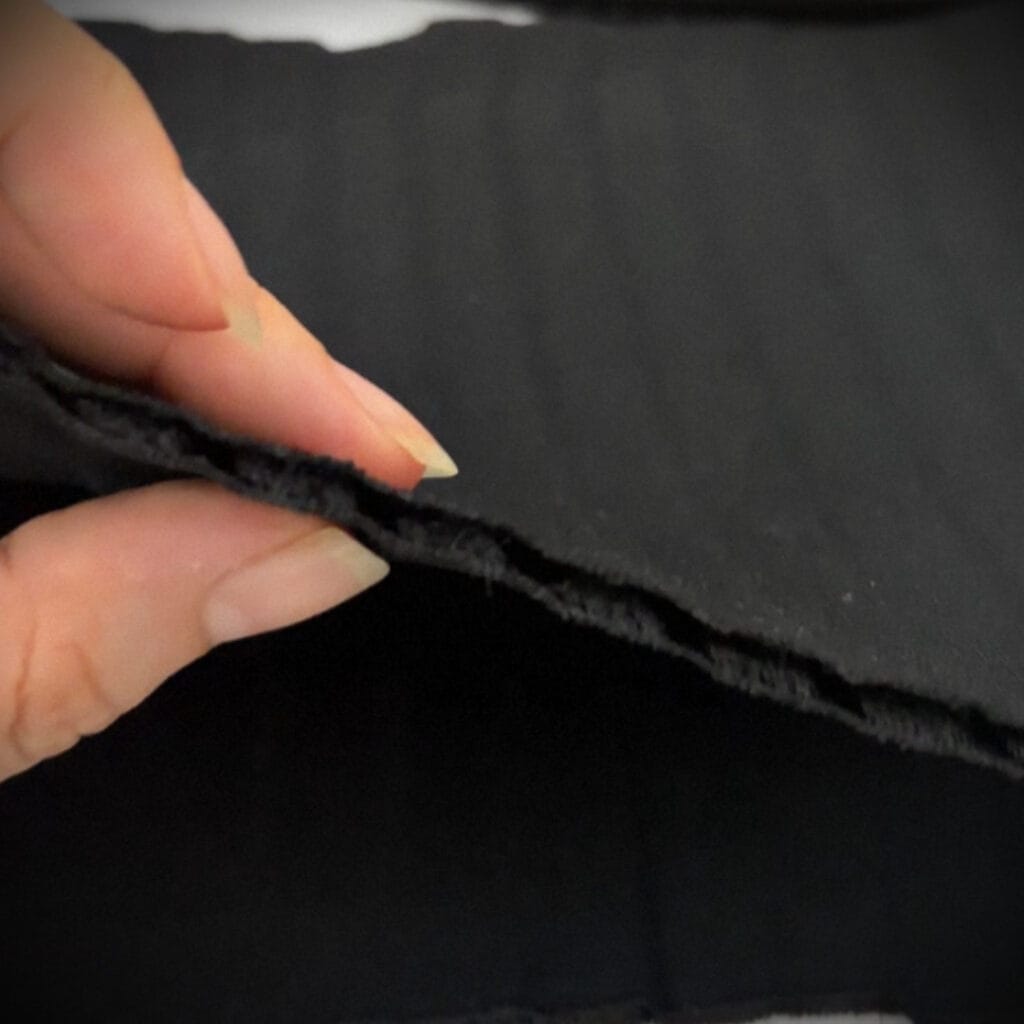
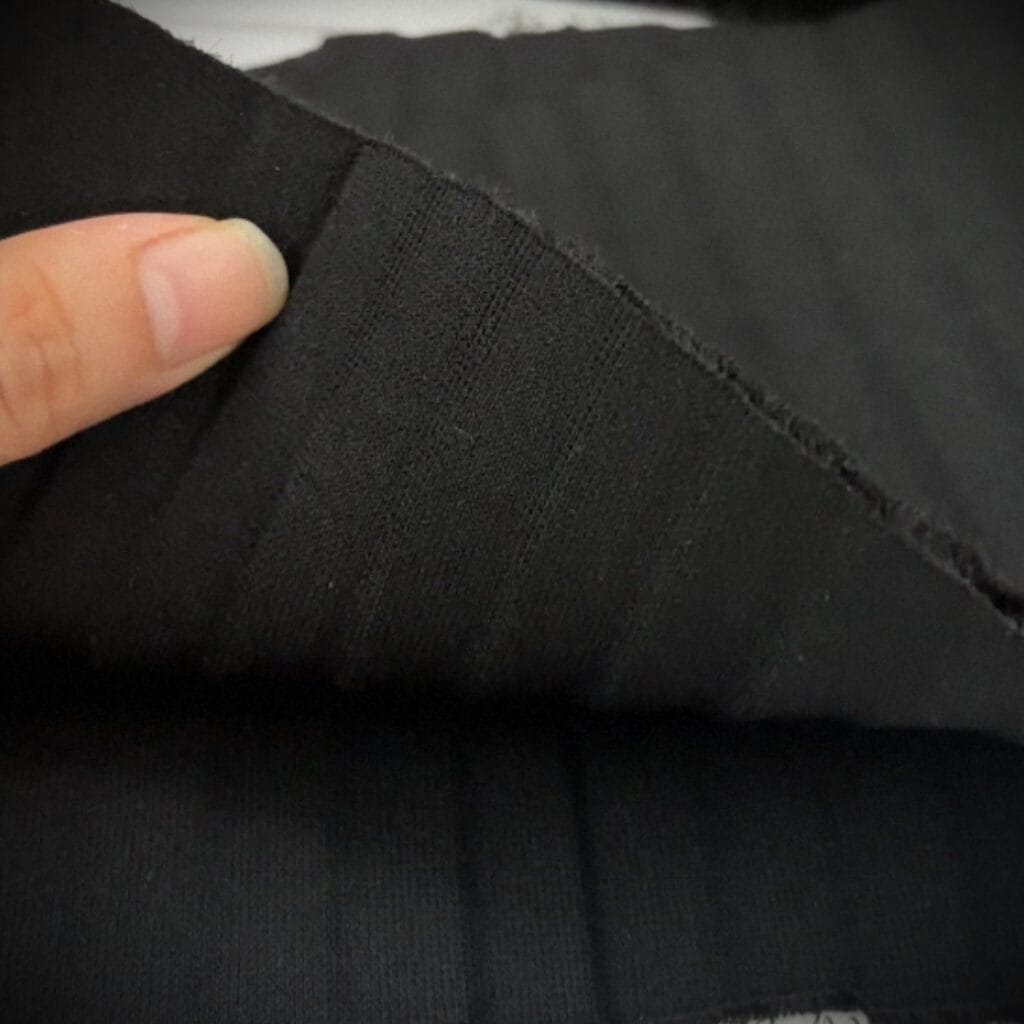
Problem A: Eliminating Monofilament Crowding and Fabric Lift-Off
In standard spacers, bending forces monofilaments to collide, creating high flexural rigidity. AG505’s channels provide dedicated deformation relief zones.
Under bending, the adjacent monofilament ribs can deflect slightly into the channel voids rather than binding against one another. This distributes a single, high-stress buckling point across multiple micro-hinges. The result is a smooth, continuous curvature that remains flush against the patella and popliteal space throughout articulation, significantly reducing dynamic shear and chafing.
Problem B: Overcoming Heat Accumulation Through Dynamic Micro-Venting
Knee braces routinely suffer from thermal and moisture accumulation, especially behind the knee. In continuous spacer fabrics, horizontal air permeability through the middle layer is hindered by the dense monofilament network.
AG505’s longitudinal channels create uninterrupted micro-conduits between the skin-contact layer and the exterior environment. As the user walks, runs, or cycles, the cyclic flexion and extension of the joint exerts a dynamic pumping effect (bellows mechanism) on these channels—actively driving warm, humid air outward and drawing ambient air inward.
For a broader discussion of support, microclimate and processing considerations, see our five technical questions about 3D airmesh for medical braces.
AG505 at a Glance
| Item | AG505 |
|---|---|
| Development basis | Customized version of AG504-2 |
| Fabric weight | 415 g/m² |
| Fabric width | 142 cm |
| Distinguishing structure | Regularly separated monofilament support regions with channels in the spacer layer |
| Intended application | Knee supports, with further brace and support applications to explore |
| Design focus | Fabric conformability and internal ventilation |
Potential Applications Beyond Knee Supports
Beyond knee supports, several types of braces and body-contact padding merit sample evaluation when fabric conformability and internal airflow are development priorities. Potential components and evaluation questions include:
| Potential application | Component to explore | Main sampling question |
|---|---|---|
| Wrist and elbow supports | Flexible wrap sections or lining panels | How well does the fabric accommodate smaller curves and repeated bending? |
| Ankle supports | Contoured textile panels or liners | How do channel orientation and seams affect the fabric's ability to conform to curved surfaces? |
| Lumbar supports | Body-facing panels | What happens to the channels under belt tension and compression? |
| Orthotic liners and wearable strap padding | Textile interfaces beneath a shell or strap | How does the fabric behave when constrained by the surrounding assembly? |
These are potential development directions for AG505, with suitability to be established through sampling. Evaluation should reflect the fabric’s intended role within the finished assembly.
Prototyping & Patterning Recommendations for R&D Teams:
Test Channel Orientation Relative to Joint Axes:
Because AG505 features directional channels, grain line placement on pattern pieces is critical.Aligning channels perpendicular to the limb’s long axis maximizes flexural ease (ideal for the knee crease or elbow flex point).
Aligning channels parallel to the limb provides superior circumferential contouring around cylindrical muscle contours while retaining longitudinal tension.
2. Evaluate edge termination and bonding areas:
At 415 GSM, AG505 offers substantial body for structural bracing. When prototyping, evaluate how the channel geometry interacts with your secondary processing—such as ultrasonic welding, silicone grip application, or stretch-tape binding. The channel structure allows for flatter seam compression without monofilament blowout at stitch lines.
Custom Engineering & Compliance Options
Beyond structural geometry, AG505 can be customized at the fiber and finishing levels to meet strict medical, industrial, or regulatory standards:
Medical-Grade Biocompatibility: Formulations engineered to pass ISO 10993 evaluations (cytotoxicity, skin irritation, and sensitization) for direct or prolonged skin contact.
Functional Finishes: Tailored treatments including certified Flame Retardancy (FR), antimicrobial protection, OEKO-TEX® compliance, or custom water-repellent/wicking chemistries.
Yarn & Spec Tweaks: Adjustments to face yarn composition (e.g., recycled content, specific deniers) or channel spacing to match your product’s targeted compression profile.
Request an AG505 Sample for Your Project
AG505 offers a channel-based variation of the AG504-2 spacer construction for developers considering how brace and support fabrics conform to body contours and allow internal airflow.
Contact our team to request swatches or sample yardage of AG505 (415 GSM / 142 cm) for your technical wear or medical brace prototyping. Share your intended layering, target dimensions and evaluation priorities so we can help you review AG505 against your existing fabric.