
In our previous engineering guides, we explored how PP spacer mesh performs in sleeveless sports jerseys and outerwear linings. We also showed how a zoned knit layout prevents wet-cling in men’s athletic underwear.
However, those categories only scratch the surface of sweat management. Across apparel and protective gear, severe microclimate failures happen where airflow disappears. Tight bands, loaded pockets, heavy pack straps, and rigid foam all block ventilation. As a result, trapped perspiration turns ordinary fabrics into cold, clammy layers.
Please note: This article is not a rigid specification sheet or catalog prescription. Instead, it is an open engineering ideation piece. Below, we explore six promising concepts for PP spacer mesh where a hydrophobic inner face and wicking outer knit show strong potential. Alongside each concept, we also list the exact variables that brand teams and our mill must validate during prototyping.
6 High-Sweat Concepts for PP Spacer Mesh
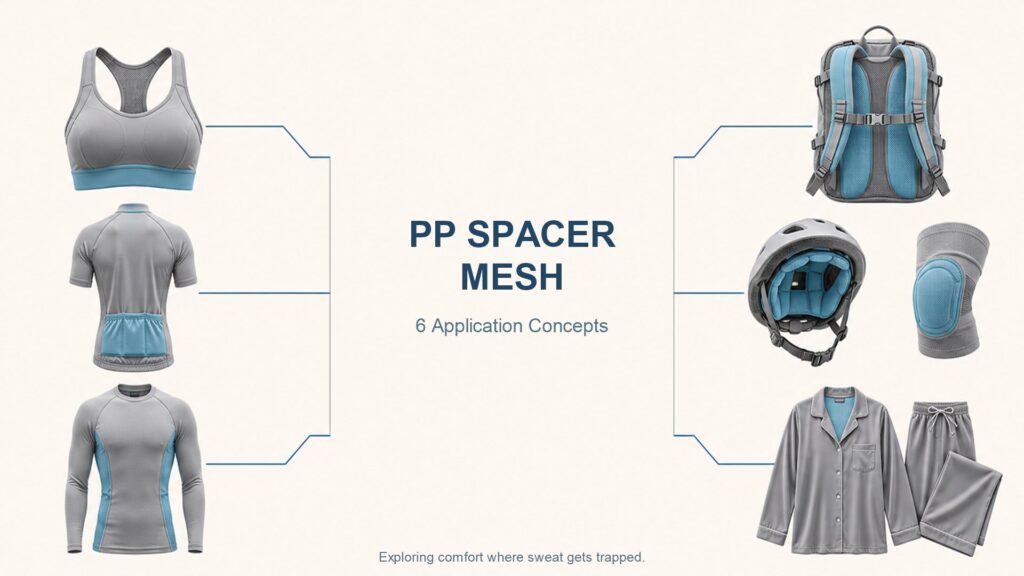
1. Women’s High-Impact Sports Bras: Tackling Underband Friction
The Microclimate Bottleneck:
In high-impact sports bras, heat and sweat pool rapidly along the underband, center gore, and spine. Most designs rely on thick foam cups laminated to standard polyester-elastane knits. Once saturated, the underband becomes heavy and abrasive. Consequently, athletes experience chafing, heat rash, and post-workout chill against sensitive skin.Why the Material Logic Fits:
Using PP spacer mesh as an inner lining tackles two issues at once. Because polypropylene (olefin fiber) exhibits extremely low moisture absorption, the skin-contact layer refuses to hold sweat inside its fibers. Instead, it pushes moisture outward into the wicking exterior. Meanwhile, a spacer knit structure adds gentle opacity without relying solely on suffocating foam.What Needs Testing in Prototyping:
Stretch and Recovery: High-support bras demand high modulus and reliable snap-back. Therefore, testing must evaluate how adding spandex affects the moisture-transfer path.
Next-to-Skin Softness: Brand teams should validate yarn denier and knit smoothness to prevent friction during repetitive movement.
2. Endurance Cycling Kits: Beating Heat Under Loaded Pockets
The Microclimate Bottleneck:
Endurance cyclists lean forward for hours under intense thermal load. Specifically, two zones suffer the most: the lower back and the shoulders. Loaded rear jersey pockets press damp fabric tightly against the spine. In addition, bib straps trap sweat across the chest and collarbone. The moment a rider hits a fast descent, soaked fabric turns freezing cold in the wind.Why the Material Logic Fits:
A lightweight PP spacer mesh structure separates bare skin from damp outer surfaces. Even when pockets press against the lower back, tiny spacer channels disperse sweat vapor outward. Furthermore, the hydrophobic inner face stops a cold, wet film from clinging to the rider’s skin during descents.What Needs Testing in Prototyping:
Aerodynamic Fit and Stability: Ultra-light knits still need enough dimensional stability so loaded jersey pockets do not sag.
UV Protection and Durability: Cycling brands must test UPF ratings for multi-hour sun exposure alongside snag resistance against saddle bags.
3. Alpine Base Layers: Eliminating the "After-Chill" Effect
The Microclimate Bottleneck:
Ski touring, winter trail running, and alpine trekking share a dangerous thermal cycle. Athletes sweat heavily during steep climbs, yet face freezing winds on exposed ridgelines. Natural fibers like cotton hold liquid inside the yarn core. Even worse, many chemically treated synthetics stay damp against the body. That trapped moisture rapidly steals body heat the second movement stops.Why the Material Logic Fits:
First, the inner face pushes liquid sweat outward to the wicking polyester layer. Next, dry micro-pockets inside the knit trap insulating air once the wearer reaches the summit.What Needs Testing in Prototyping:
Warmth-to-Breathability Ratio: Developers must balance knit loft and fabric weight so the garment vents uphill without feeling drafty at rest.
Multi-Day Odor Behavior: Field trials should check how keeping the skin-contact side dry slows odor buildup over multi-day trips.
4. Backpacks & Utility Vests: PP Spacer Mesh Airflow Under Pressure
The Microclimate Bottleneck:
Strap on a 15 kg trekking pack or a heavy utility vest, and normal ventilation vanishes. Standard polyester air meshes often flatten completely under load. As a result, they soak up sweat like a sponge, gain weight, and cause uncomfortable back rashes.Why the Material Logic Fits:
When heavy gear blocks airflow, a lining needs structural loft and a dry contact face. A heavier PP spacer mesh panel keeps tiny airflow channels open under strap pressure. At the same time, its hydrophobic surface stops pooled sweat from soaking back into the wearer’s shirt.What Needs Testing in Prototyping:
Compression Recovery: Engineers must measure how well 3D spacer yarns bounce back after prolonged pressure from heavy pack frames. Abrasion and Velcro Resistance: Utility gear demands strict snag testing, especially where linings rub against coarse webbing or hook-and-loop fasteners.
5. Helmets, Pads & Orthopedic Braces: Replacing Sweat-Soaked Foam
The Microclimate Bottleneck:
Ski helmets, knee pads, lumbar supports, and orthopedic braces share one glaring flaw: closed-cell neoprene or thick foam. While foam absorbs impact and stabilizes joints, it traps 100% of body heat against the body. Consequently, wearers struggle with itching, skin irritation, and lingering odors.Why the Material Logic Fits:
Gear makers do not need to redesign outer shells or structural padding to fix skin comfort. Swapping just the inner contact layer for PP spacer mesh creates a dry barrier over the foam. Therefore, sweat moves away from the scalp or joint, helping pads dry faster between sessions.What Needs Testing in Prototyping:
Lamination Thermal Limits: Because polypropylene melts at a lower temperature than standard polyester, bonding it to EVA or foam requires careful heat control.
Wash and Sweat-Oil Durability: Lab tests must confirm adhesive peel strength after repeated hand-washing and exposure to skin oils.
6. Anti-Night-Sweat Sleepwear: Solving the 3 A.M. Wet-Cling Trap
The Microclimate Bottleneck:
Demand for cooling sleepwear—serving hot sleepers, menopause care, and athletic recovery—has grown fast. However, most brands default to bamboo viscose, modal, or brushed cotton. As we noted when examining the cotton and modal moisture trap, cellulose fibers absorb sweat eagerly. Consequently, sleepers wake up at 3 a.m. wrapped in a cold, damp sheet of fabric.Why the Material Logic Fits:
Extending PP spacer mesh from daytime sports to sleepwear offers a practical alternative. Instead of holding night sweats against the back, the inner face moves vapor outward into the bedding air. Thus, the sleeper avoids that jarring swing from overheating to clammy chills.What Needs Testing in Prototyping:
Sleep-Grade Hand-Feel: Loungewear buyers reject stiff or noisy synthetics. Therefore, fine-denier softness and fluid drape are essential.
Home Laundry Care: Prototyping must verify shrinkage, pilling resistance, and softness after frequent domestic washing and low-heat drying.
Conceptual Summary: PP Spacer Mesh Prototyping Matrix
| Application Concept | Core Microclimate Bottleneck | Why the Material Logic Fits | Key Prototyping Variables |
| Sports Bras | Underband sweat pooling and chafing | Dry skin barrier plus breathable opacity | Elastane stretch/recovery, soft hand-feel |
| Cycling Kits | Heat trapped under pockets and bib straps | Moisture transfer under light pocket pressure | Aerodynamic modulus, UPF, snag resistance |
| Alpine Base Layers | Post-climb “after-chill” in high wind | Zero-regain inner face plus dry air pockets | Warmth-to-weight loft, multi-day odor |
| Packs & Utility Vests | Mesh flattening and heat rash under load | Compression-resistant channels plus dry contact | Load recovery, abrasion, Velcro snagging |
| Helmets & Braces | Sweat-soaked neoprene and foam odor | Dry interface separating skin from padding | Low-temp lamination, wash peel strength |
| Recovery Sleepwear | Damp, cold modal clinging at 3 a.m. | Continuous 8-hour dry skin interface | Quiet ultra-soft drape, laundry shrinkage |
From Concept to Prototype: Testing PP Spacer Mesh with ZFY
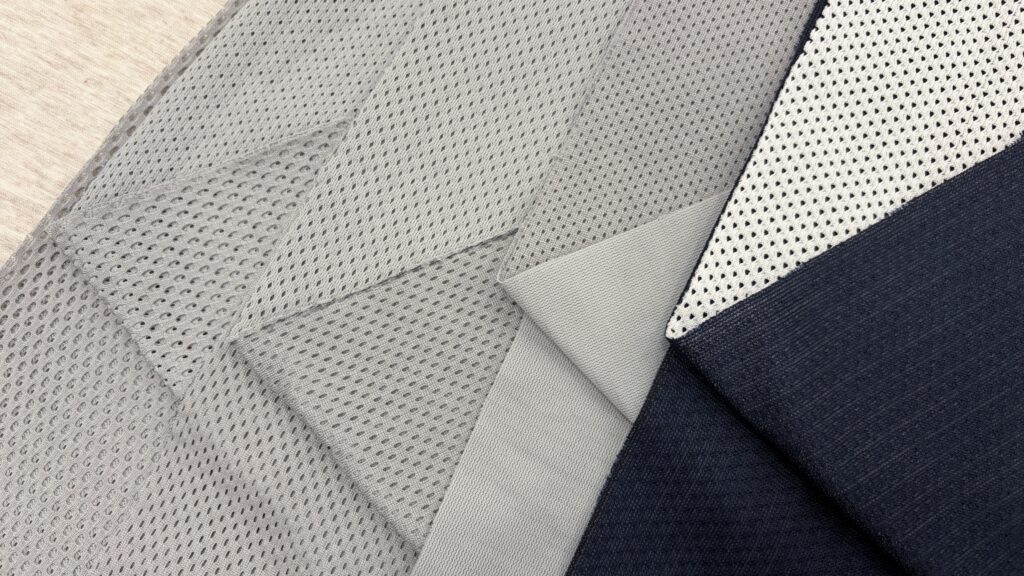
At ZFY, our baseline PP spacer mesh series already covers a versatile engineering range. Specifically, our existing structures span from ~130 gsm open-mesh knits and ~140 gsm micro-meshes to ~180 gsm opaque knits and ~255 gsm structural 3D spacers. Starting from those baselines, our OEM/ODM team can help you adjust blend ratios, add spandex for stretch, boost abrasion resistance with high-tenacity yarns, or customize GSM and cuttable width.
Ready to run a proof-of-concept trial?
Share your project brief with the ZFY Fabric Engineering Team. Tell us your target category, your primary sweat or friction bottleneck, and your desired hand-feel or stretch profile. We will send relevant baseline swatches or discuss a custom R&D knit together.