
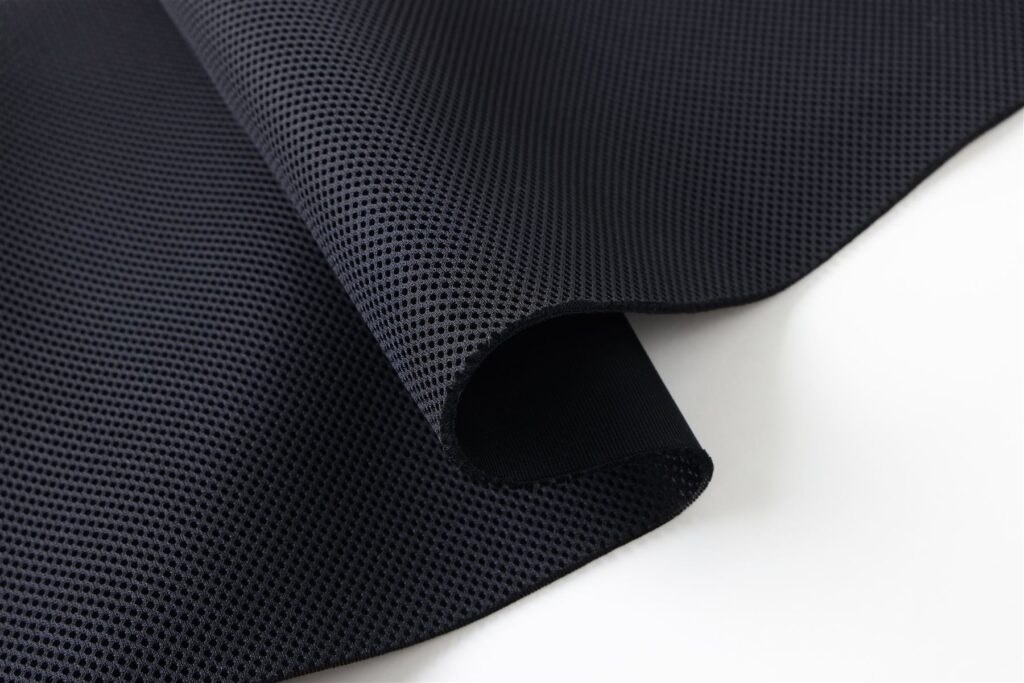
Many customers have recently selected W403 for wheelchair fabric sampling projects. Unlike general office upholstery or casual sports mesh, wheelchair fabrics must address three critical challenges simultaneously: skin biocompatibility for continuous direct contact, stringent public flammability compliance, and active microclimate regulation to prevent pressure ulcers (bedsores).
W403 samples have passed ISO 10993-5, EN 1021-1, and EN 1021-2 testing. And this article explains the fabric’s specifications, where it may fit in a wheelchair design, and what manufacturers should check during sampling.
W403 Fabric Specifications
| Property | W403 Specification |
|---|---|
| Fabric type | Polyester spacer fabric |
| Target weight | 250 ± 25 g/m² |
| Target thickness | 2.8 ± 0.3 mm |
| Effective width | 1,470 mm (+50/–0 mm) |
| Full width, edge to edge | 1,500 mm (+60/–0 mm) |
Proven Dual Compliance: ISO 10993-5 and EN 1021-1 & EN 1021-2
In medical seating design, passing flammability tests often compromises biocompatibility because aggressive chemical flame retardant (FR) back-coatings can leach toxic compounds. W403 was developed from the ground up to eliminate this trade-off ( Click here for the certification of W403 ).
ISO 10993-5 (In Vitro Cytotoxicity): W403 has successfully passed ISO 10993-5 testing, verifying that neither the base polymer nor the finishing chemicals exhibit cytotoxic effects on cellular health.
EN 1021-1 & EN 1021-2 (Flammability Standards): W403 meets both Part 1 (smouldering cigarette) and Part 2 (match flame equivalent) of the European upholstered furniture and seating safety standards.
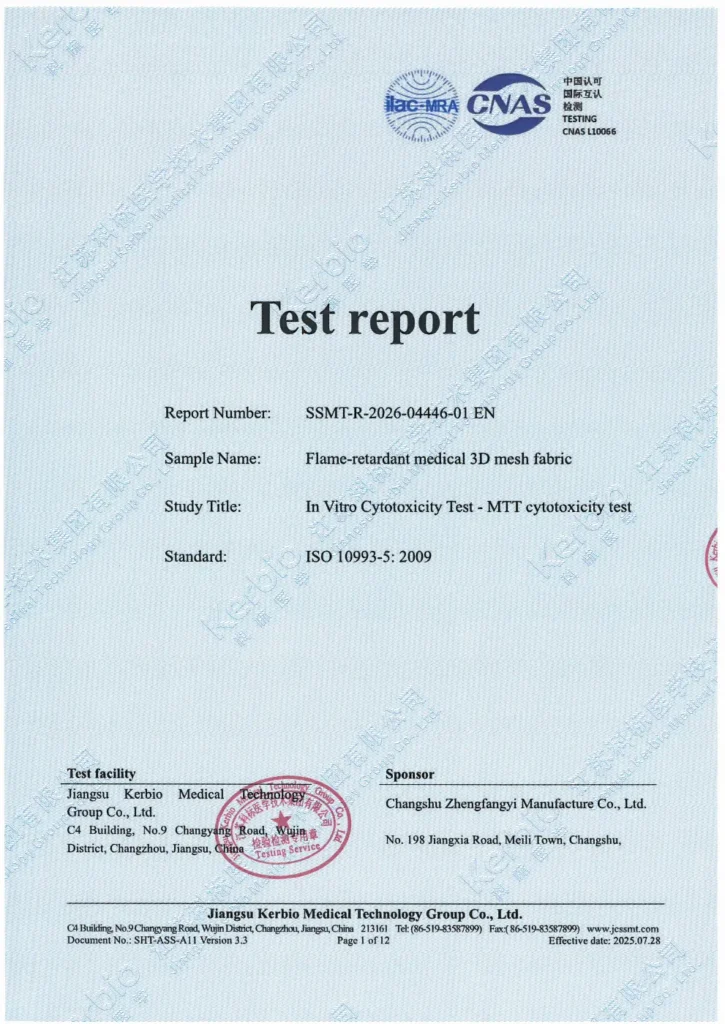
If you have previously experienced compliance conflicts when attempting to balance fire resistance with non-toxicity, you can explore the underlying chemical and finishing process in our in-depth case study on solving cytotoxicity and EN 1021 for medical fabric.
Key Application Scenarios in Mobility Seating
Cushion covers. W403 can be sampled as a fabric for removable or fixed cushion covers. During development, check how it handles cutting, seams, edge binding, and contact with the selected cushion material. Evaluate the complete cushion rather than assuming the fabric alone determines seating performance.
Backrest panels. Its mesh surface and spacer construction also make W403 worth evaluating for upholstered backrests. Prototype the panel under the intended tension and attachment method, then check its appearance and feel after repeated use.
Other upholstered areas. Side panels and similar padded components may use a different fabric construction from the main seat. W403 can be considered for these areas when its thickness, hand feel, and finished appearance suit the design.
Material Selection Comparison
Need orthopedic brace conformability? If your current project centers on close-fitting joint supports or limb orthotics requiring higher omni-directional flexibility, consider our AG505 spacer fabric for orthopedic braces.
Need advanced antimicrobial barrier protection? For high-dependency clinical environments, long-term care facilities, or incontinence mattress covers, review our specialized antimicrobial mesh solutions for wheelchair cushions and bedsore mattresses.
Evaluate W403 for Your Wheelchair Project
A useful sample review starts with the fabric’s intended role. Before requesting W403 yardage or preparing a test assembly, define:
- The application area: cushion cover, backrest, side panel, or another component.
- The surrounding materials: foam, other filling, backing, adhesive, or laminated layers.
- The manufacturing process: cutting, sewing, binding, lamination, and any additional finishing.
- The use and care requirements: expected contact, cleaning method, and replacement cycle.
- The testing scope: target market, required standards, and whether testing applies to the fabric sample or a finished material combination.
Material selection and processing should be reviewed together. Our article on biocompatibility challenges in wheelchair cushion fabrics offers further context on why the composition and processing history of a sample matter during development.
Is W403 the Right Spacer Mesh for Your Design?
W403 is a polyester spacer fabric with a 250 g/m² target weight and 2.8 mm target thickness. Those specifications make it a defined option for wheelchair seating teams to compare against their current cover or backrest material.
Request a W403 Sample
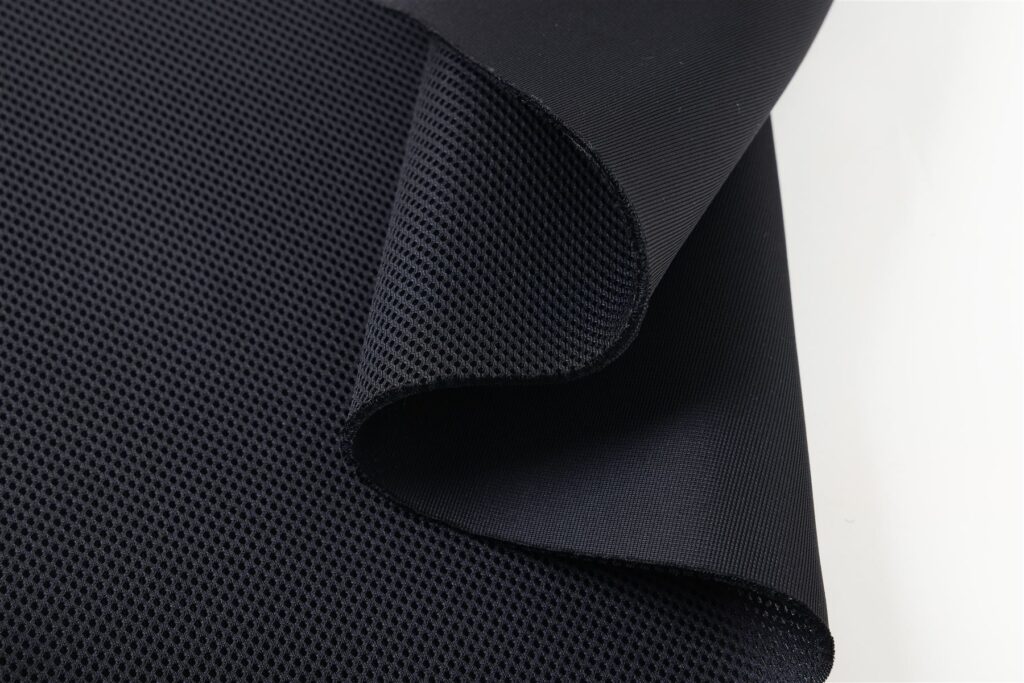
If you are developing a wheelchair cushion, backrest, or upholstered seating component, contact our team to request a W403 sample. Share your intended construction and testing requirements so we can provide the most relevant fabric information for your evaluation.
FAQ
Has W403 passed ISO 10993-5 and EN 1021 testing?
Yes. Customer-submitted W403 samples have passed ISO 10993-5, EN 1021-1, and EN 1021-2 testing. Ask our team for the relevant report details when reviewing W403 for your project, including how the tested sample relates to your proposed construction.
Can W403 be sampled for both wheelchair cushions and backrests?
Yes. Both are suitable areas for prototype evaluation. The final selection should be based on the complete component design, including its filling, attachment method, seams, and required tests.
What should I send when requesting a W403 sample?
Tell us where the fabric will be used, the dimensions or yardage you need, the materials it will be combined with, your processing requirements, and your target testing standards. A photograph or physical sample of your current fabric is also helpful.