Traditional Filter Meshes Are Being Disrupted
For decades, engineers and procurement managers have faced a persistent compromise when selecting filtration media.
Conventional wire meshes and flat woven screens offer minimal air or water resistance, but they only provide surface-level sieving. Conversely, meltblown nonwovens, cellulose filter papers, and reticulated foams capture finer particles, but they collapse easily under pressure, tear when wet, and create massive landfill waste as single-use consumables.
Today, technical textiles are rewriting these rules.
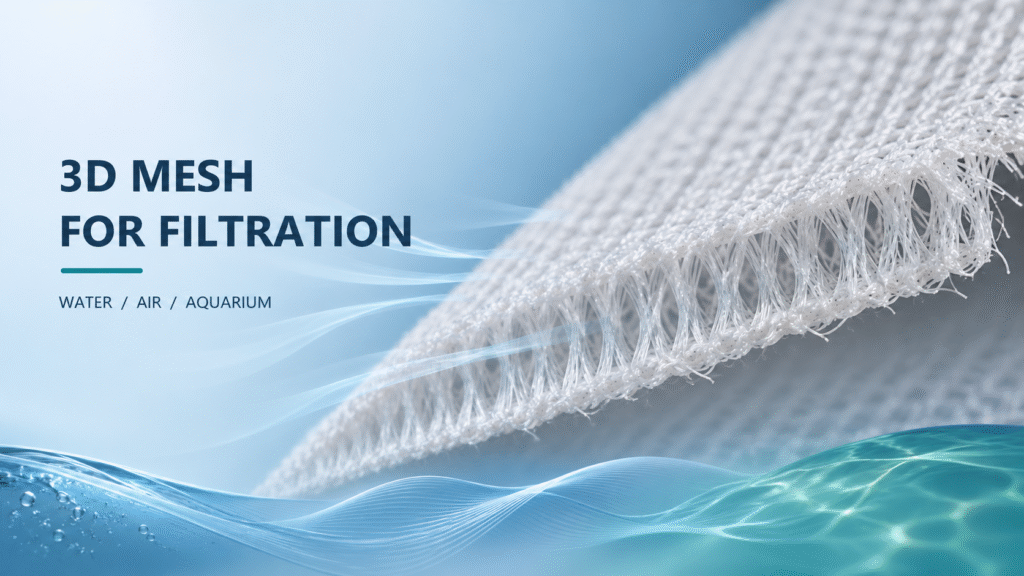
3D mesh fabric for filtration—widely known as warp-knitted spacer fabric—has emerged as a transformative solution across industrial and commercial equipment. By combining two outer textile faces with thousands of vertical polyester monofilament pillars, this engineered material creates an open, three-dimensional labyrinth.
In this comprehensive guide, we unpack the micro-mechanics of 3D spacer media and present ZFY’s engineered fabric recommendations across three critical filtration applications.
Deconstructing the Filtration Mechanism of 3D Mesh Fabric
To select the right media, you must first understand how a warp-knitted spacer textile functions under fluid flow. Unlike 2D screens that filter strictly on a planar surface, 3D spacer fabrics utilize depth filtration combined with micro-channel hydrodynamics.
Depth Filtration Through a Monofilament Labyrinth
When air or liquid penetrates the surface mesh, it enters an internal matrix supported by vertical monofilament yarns. These pillars force the fluid to follow a tortuous, winding path. Suspended particles collide with the dense monofilament network through inertial impaction and interception, trapping contaminants throughout the entire 2.5 mm to 3.0 mm thickness rather than merely caking the exterior.
Compressive Resistance and Anti-Collapse Integrity
Traditional fibrous pads often pancake under continuous hydraulic or pneumatic loading, which immediately chokes fluid channels. In contrast, 100% polyester (PET) monofilaments act like micro-structural columns. They preserve open internal flow channels even under elevated pressures, ensuring stable flow rates and predictable pressure drops.
ZFY Fabric Recommendations for Diverse Filtration Scenarios
At ZFY, our warp-knitting lines engineer distinct spacer fabrics tailored to specific fluid viscosities, operational pressures, and maintenance protocols. Below are our three fabrics designed for water treatment, HVAC ventilation, and aquatic life support.
A. Industrial Wastewater & Sludge Dewatering: K420
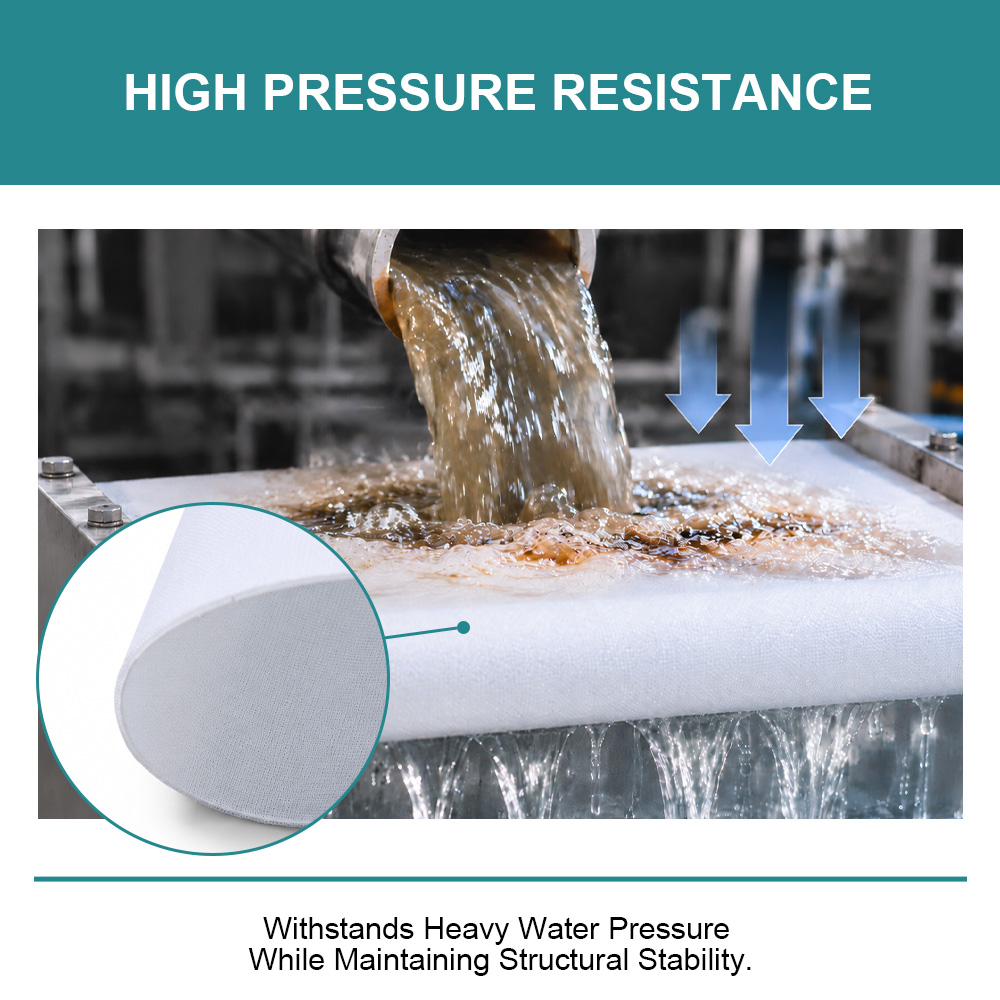
Dimensions & Thickness: 390 gsm × 160 cm | 2.7 mm
Composition: 100% Heavy-Duty Polyester (PET)
Knitting Technology: High-Precision Imported RD Double-Needle Bar Machine
Engineering Focus:
Industrial sludge dewatering (such as plate-and-frame filter presses or belt dewatering systems) subjects filter media to intense mechanical compression. If the spacer fabric yields, the internal drainage core seals shut.
K420 is engineered with ultra-stiff spacer monofilaments knitted on imported Karl Mayer RD machines. This construction delivers exceptional dimensional stability and compressive resistance:
Zero Structural Collapse: Maintains lateral fluid escape routes even when subjected to severe hydraulic clamp pressures.
Flat Cake-Release Face: The contact surface is exceptionally smooth, allowing dehydrated sludge cakes to peel away cleanly without clogging the pore openings.
B. Air & Commercial HVAC Filtration: K612
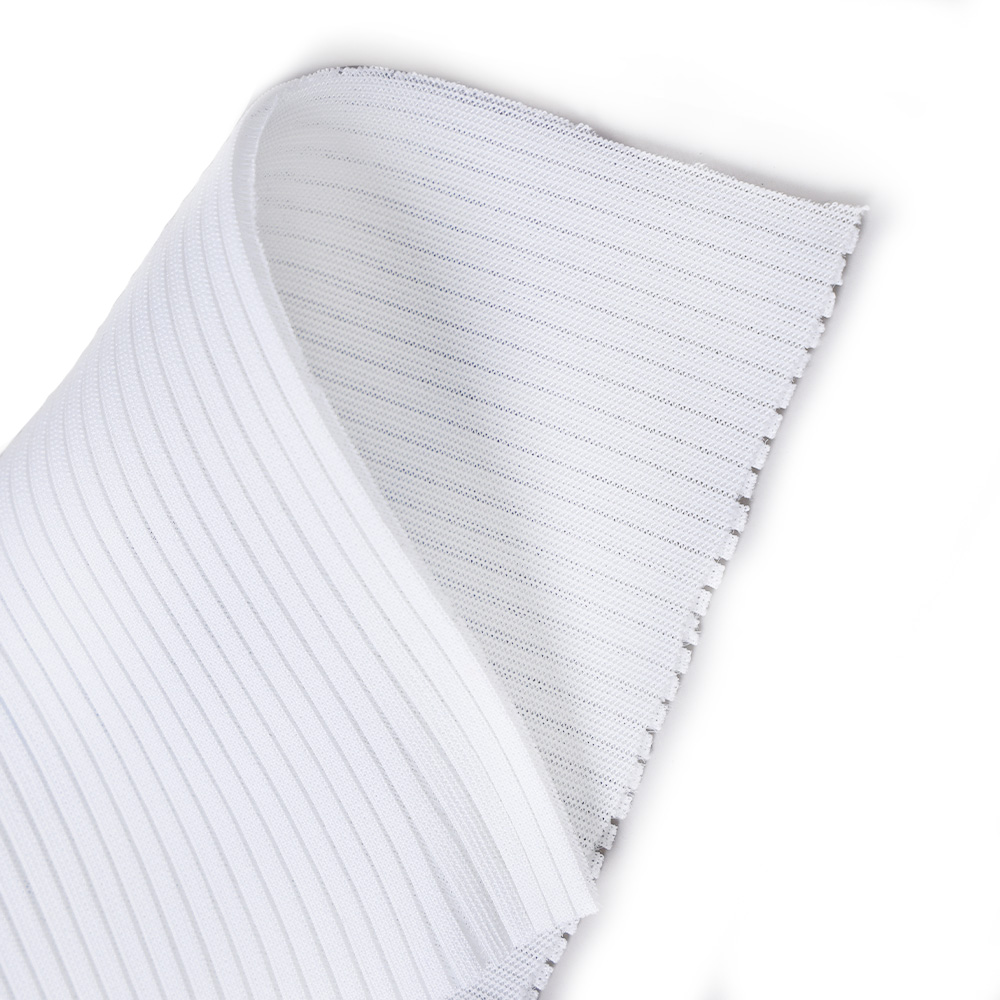
Dimensions & Thickness: 250 gsm × 160 cm | 3.0 mm
Composition: 100% Polyester (PET)
Knitting Technology: High-Precision Imported RD Double-Needle Bar Machine
Engineering Focus: Washability & Depth Dust-Holding Capacity
Commercial buildings, data centers, and cleanroom pre-filtration setups consume thousands of disposable fiberglass or paper panel filters every year. K612 replaces these single-use items with a washable alternative.
Its 3.0 mm depth architecture captures airborne dust, lint, and aerosols within its internal matrix:
High Reusability: 100% hydrophobic polyester resists rotting and mildew. Maintenance personnel can repeatedly pressure-wash, dry, and reinstall the panels.
Engineering Trade-off (Air Resistance): Because of its 3.0 mm thickness and dense internal monofilament forest, K612 exhibits higher initial static pressure drop than thin plastic screens. It requires blowers with adequate static pressure.
C. Aquarium & Aquatic Bio-Separation: YH-G-300
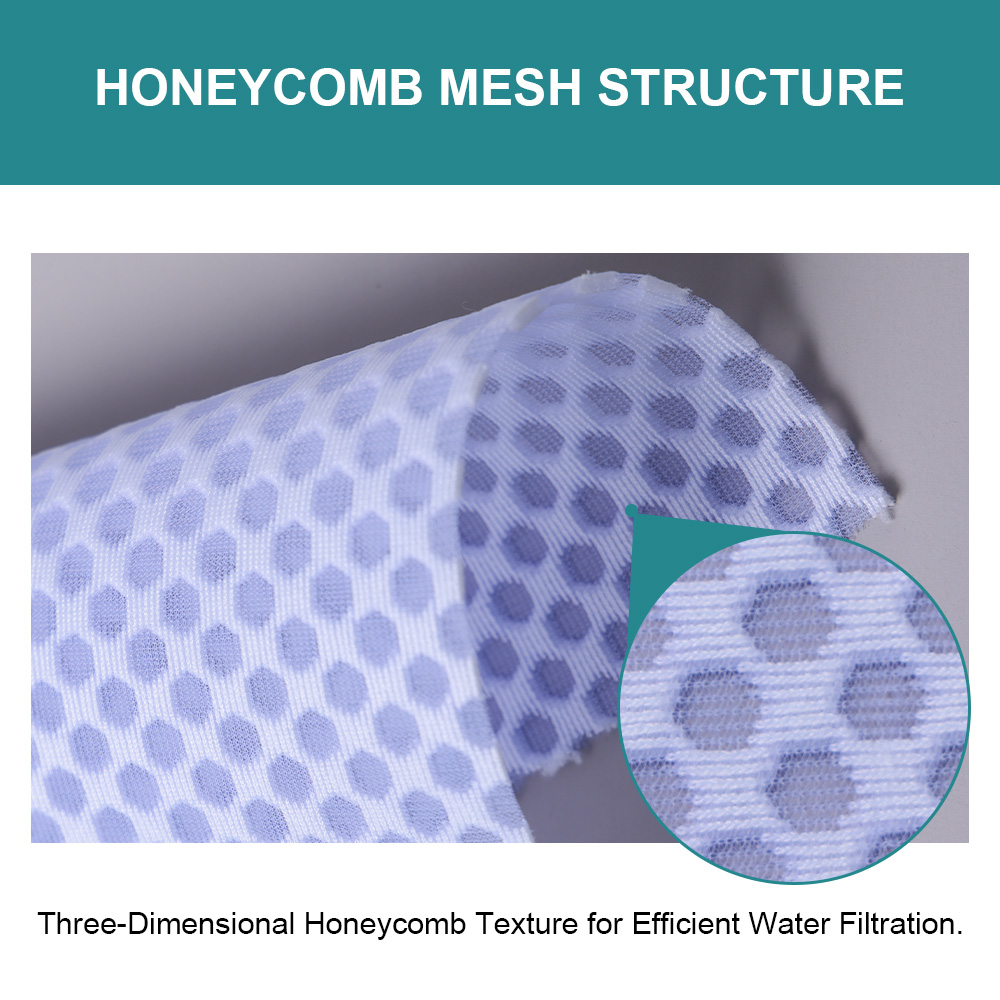
Dimensions & Thickness: 300 gsm× 150 cm | 2.5 mm
Pore Geometry: Engineered 3D Honeycomb Structure
Knitting Technology: Conventional 286 or RD Double-Needle Bar Machine
Engineering Focus: Honeycomb Trapping of Viscous Suspended Solids
In freshwater aquariums, commercial aquaculture sumps, and koi pond trickle boxes, the filtration challenge shifts from dry dust to biological colloids—namely fish waste, uneaten protein pellets, and microbial biofilms.
YH-G-300 features an open, hexagonal honeycomb face:
Organic Muck Capture: The recessed honeycomb cells act as micro-pockets that instantly trap gelatinous biological muck, preventing it from bypassing the filter bed and polishing the water quickly.
The Reality of Bio-Clogging: Organic fish waste forms stubborn bacterial glues that cannot be fully purged once bonded inside a 2.5 mm fiber matrix. Therefore, ZFY intentionally formats YH-G-300 as a cost-effective, periodic consumable pad (often referred to as an aquarium “magic carpet”). Producing this material on either domestic 286 or RD machines keeps unit costs economical for regular changeouts.
Side-by-Side Technical Comparison Matrix
| Technical Parameters | K420 (Wastewater) | K612 (HVAC / Air) | YH-G-300 (Aquarium) |
|---|---|---|---|
| Nominal Thickness | 2.7 mm | 3.0 mm | 2.5 mm |
| Material Base | 100% Polyester (PET) | 100% Polyester (PET) | 100% Polyester (PET) |
| Surface Morphology | Flat, high-density weave | Micro-perforated breathable | Geometric 3D Honeycomb |
| Primary Advantage | Severe collapse resistance | Washable, deep dust-holding | Traps gelatinous fish muck |
| Main Limitation | Rigid; limited elasticity | Higher air resistance | Prone to organic clogging |
| Machine Technology | Imported RD Machine | Imported RD Machine | Standard 286 or RD Machine |
| Service Strategy | Long-term structural media | Reusable / Washable cycles | Periodic consumable item |
Pre-Inquiry Checklist: What ZFY Needs from You
To help our technical engineers recommend or custom-develop the ideal 3D mesh fabric for filtration, please review this quick 5-point application checklist:
Filtration Medium & Chemistry: Are you filtering municipal sewage, ambient air, or chemical liquids? Please specify working temperatures and pH ranges.
Pressure and Velocity Limits: What is your maximum allowable pressure drop? What flow velocity (m/s or CFM) will pass through the face?
Contaminant Characteristics: Are you trapping hard mineral grains, fine airborne lint, or sticky biological colloids?
Maintenance Strategy: Does your operational model require regular hot-water backwashing, or does your client demand an inexpensive drop-in replacement?
Dimensional Form Factor: Do you require full-width master rolls (e.g., 150 cm to 160 cm roll widths) or custom-cut, ultrasonic-welded shapes ready for immediate assembly?
Free Swatches and Custom Engineering Support
Selecting specialized filtration media requires physical empirical validation. ZFY can provide samples and discuss customization according to your application requirements.
Material Swatch Kits: We supply evaluation swatches of K420, K612, and YH-G-300 for tensile testing, air permeability bench checks, and sludge release trials.
Custom Knitting Parameters: Need a 4.0 mm spacer fabric with flame-retardant (FR) properties? Require a specific hexagonal pore size or high-modulus monofilament backbone? Our technical textile engineers can tailor raw material yarns, needle spacing, and thermo-setting heat profiles to match your performance envelope.
Ready to Optimize Your Filtration Equipment?
Contact our engineering sales desk today to request your sample kit or submit your technical specifications for a tailored quote.