
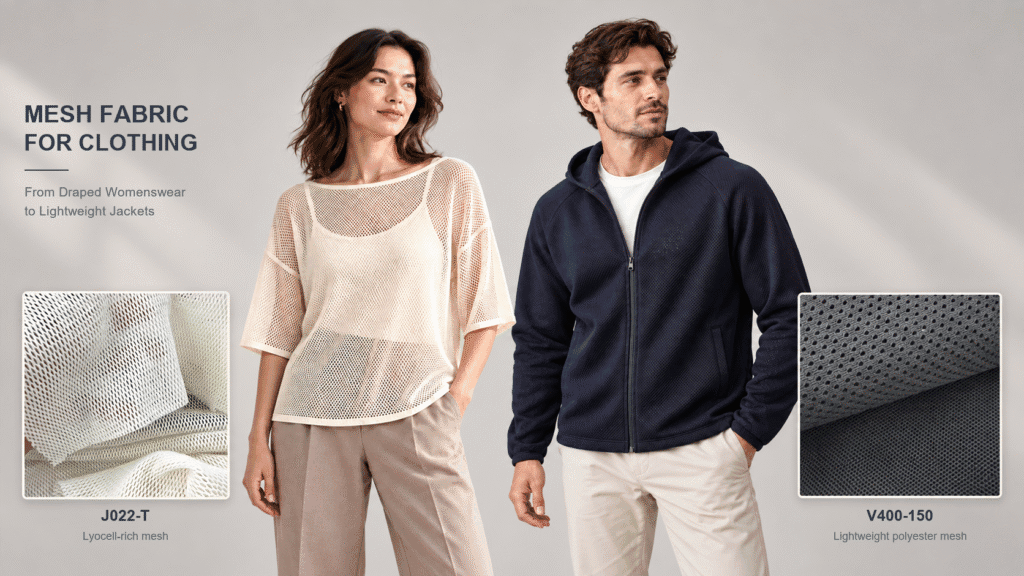
Lift a piece of J022-T, and its open mesh falls into soft folds. Pick up V400-150, and the surprise is its weight: the fabric has a substantial appearance, yet weighs so lightly.
These two new apparel mesh fabrics offer different starting points for garment development. J022-T combines a high lyocell content with natural drape and generous crosswise stretch for fashion tops and vests. V400-150 brings a soft handle, low weight, and promising moisture performance to hoodies and zip-front jackets.
For designers and sourcing teams choosing mesh fabric for clothing, these differences matter. Beyond the appearance of the openings, the way a fabric falls, feels, and works within a garment helps determine where it belongs in a collection.
J022-T: Lyocell Mesh Fabric for Draped Womenswear
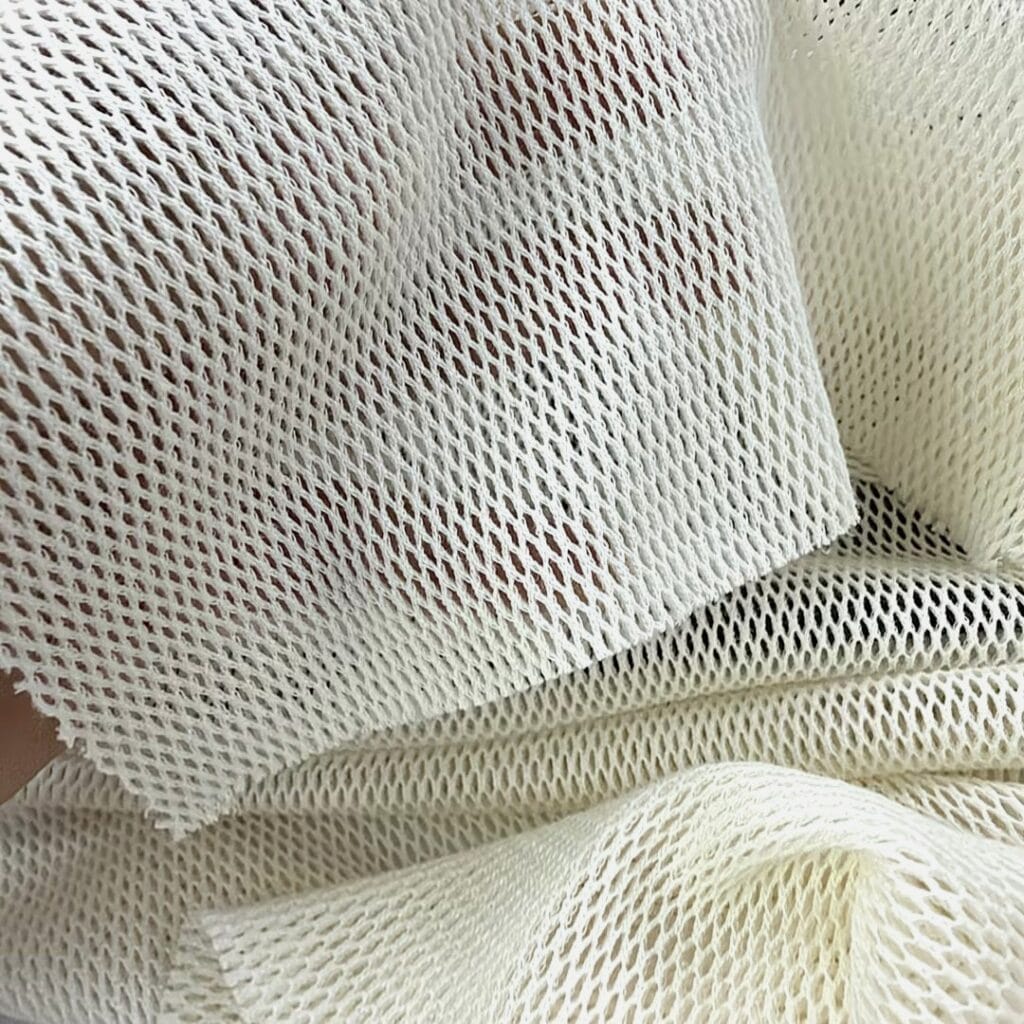
J022-T is intended for womenswear where the mesh texture forms a visible part of the design. The cream-colored sample has elongated openings that give the surface a distinct openwork appearance. When lifted or folded, the fabric bends easily and settles into flowing folds.
| Specification | J022-T |
|---|---|
| Composition | 85.8% lyocell, 14.2% polyester |
| Fabric weight | 170 gsm |
| Width | 150 cm |
| Main applications | Fashion pullover tops and fashion vests |
Tactile Profile and Knit Architecture
J022-T is built with a high percentage of Lyocell, balanced with a polyester component to provide structural stability to the open loops. Handling the sample reveals a soft, comfortable feel, while its drape gives designers another reason to consider it for relaxed womenswear.
The defining characteristic of this lyocell mesh fabric is its hand-feel. Unlike typical synthetic meshes that feel dry or wiry against bare skin, J022-T has a cool, soft, and naturally supple touch. When lifted and folded by hand, it bends without resistance, yielding soft, undulating ripples rather than sharp creases.
Its knit construction also introduces noticeable crosswise stretch. Because this horizontal give stems from the geometry of the loop formation rather than an elastane core, designers should treat it as structural mechanical stretch rather than high-recovery four-way stretch. It expands easily across the body’s horizontal contour while maintaining a direct, vertical downward hang.
Garment Applications and Sizing Behavior
Because of its drape and open surface, J022-T is primarily tailored as a mesh fabric for fashion tops, relaxed vests, and layering tunics:
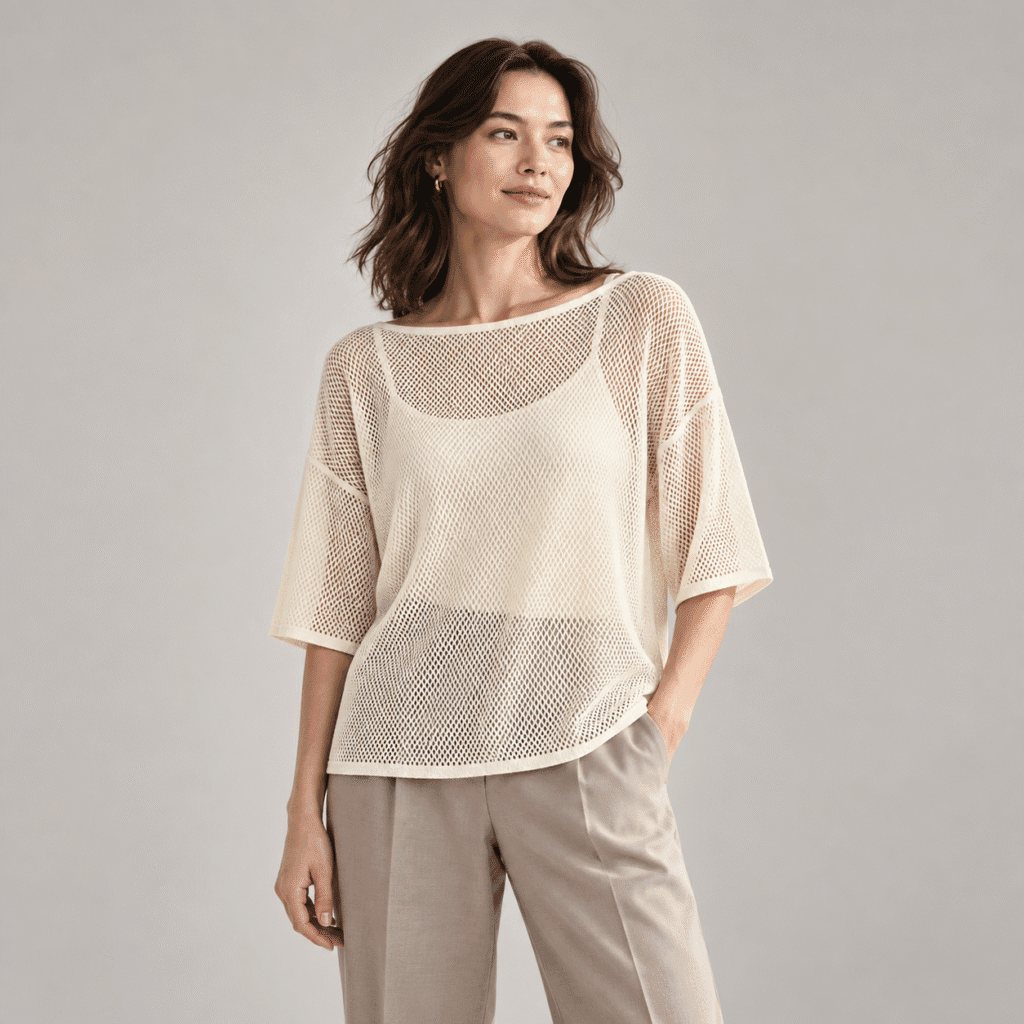
Relaxed Pullover Tops: Used as an outer layer over bralettes or tonal camisoles, allowing the geometry of the mesh to create depth without adding bulk.
Fashion Vests & Sleeveless Layers: Hanging loosely off the shoulder, utilizing the fabric’s natural weight (170 gsm) to maintain clean hem drops.
In sampling, this material has already been translated into finished one-size (free-size) womenswear pullovers. On the finished sample, the fabric falls cleanly into natural side gathers, accommodating relaxed silhouettes comfortably. However, because crosswise stretch without spandex has specific recovery limits, pattern makers should evaluate pattern ease and seam reinforcement carefully when grading beyond relaxed or one-size specifications.
V400-150: Lightweight Polyester Mesh Fabric for Hoodies and Jackets
Moving from draped womenswear to casual outer layers changes the design priorities. For V400-150, one of the most distinctive features is the relationship between its appearance and its actual weight.
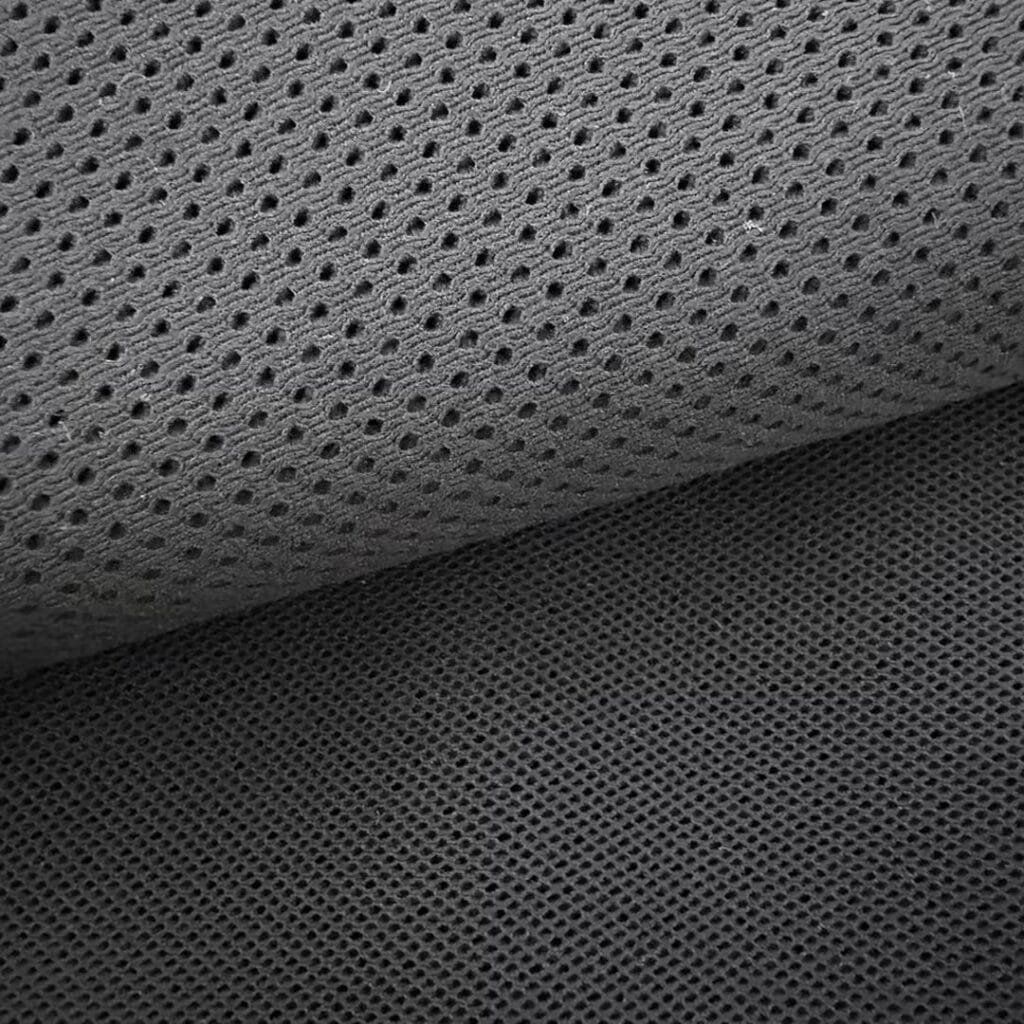
The dark navy sample looks substantial in the hand, with a fine mesh texture and a visible difference between its two faces. Yet its fabric weight is only 150 gsm.
| Specification | V400-150 |
|---|---|
| Composition | 100% polyester |
| Fabric weight | 150 gsm |
| Width | 150 cm, edge to edge |
| Main applications | Hoodies and zip-front casual jackets |
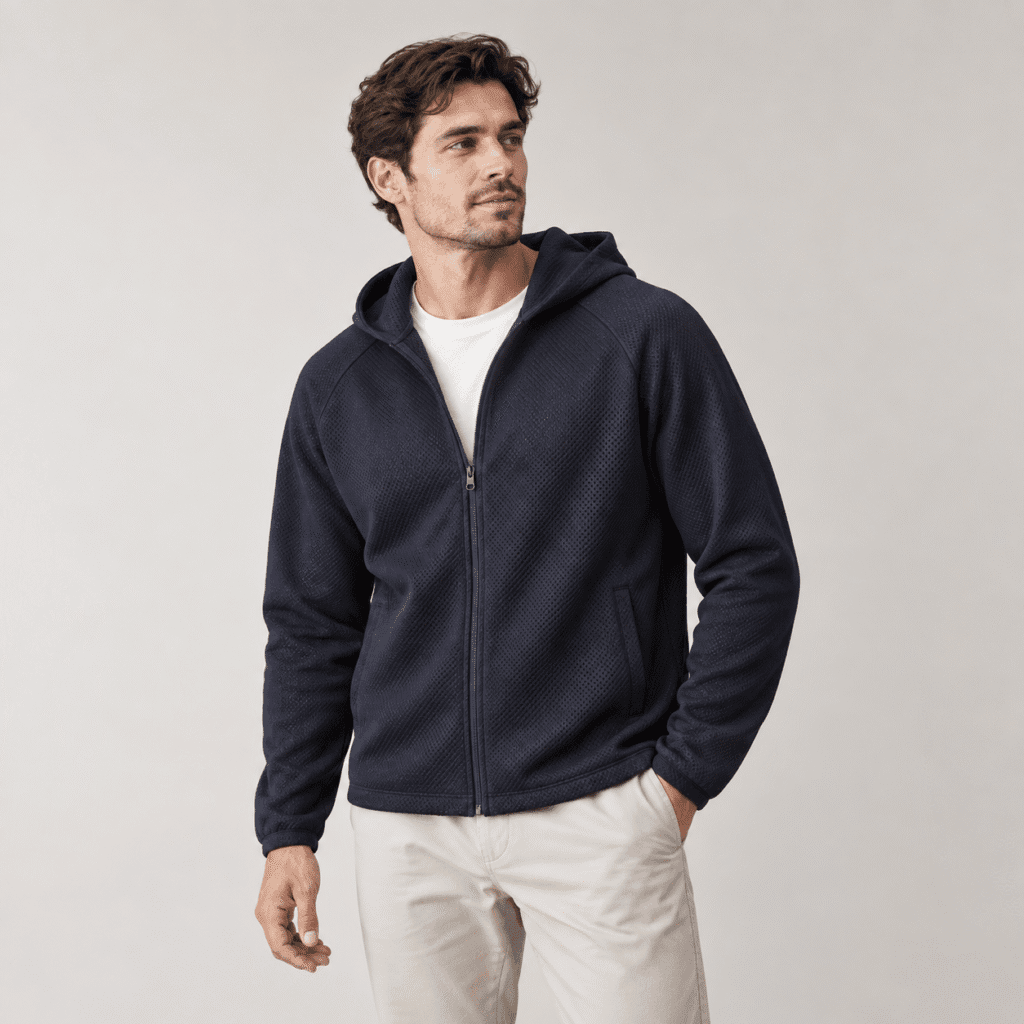
The Weight-to-Volume Disparity
V400-150 is a 100% polyester knit that presents a deliberate visual paradox. Visually, the fabric has the density, surface texture, and optical presence typically associated with a 300 gsm knit. In reality, it weighs only 150 gsm.
This profile gives pattern makers a tool to construct outerwear-style silhouettes without the accompanying weight. The fabric is finished in a deep navy and displays a distinct dual-surface structure:
Face: Features a clearly defined, technical mesh texture with fine perforations that capture light and convey an athletic aesthetic.
Back: Noticeably flatter and finer, providing a smooth hand that moves easily over base layers without clinging.
Moisture Behavior and Airflow in Light Outerwear
In prototype handling, V400-150 demonstrates rapid initial moisture intake. Droplets applied directly to the surface spread and absorb virtually immediately rather than beading up. Under ambient indoor conditions, wet fabric samples air-dried within approximately 45 minutes—an advantageous characteristic for active layering where sweat accumulation can lead to post-activity chill.
The knit’s perforated face also permits unhindered airflow, making it suitable for moderate activity or early-autumn climates where breathability takes priority over wind blocking.
Garment Applications
V400-150 serves primarily as an outer-layer mesh fabric for hoodies, full-zip track tops, and light athletic jackets:
Zip-Front Hoodies: Delivers the aesthetic fullness of an athletic sweatshirt while weighing roughly half as much, reducing neck and shoulder drag.
Transitional Pullovers & Warm-Up Tops: Offers an airy interior environment for pre-workout or travel wear.
Pocketing and Paneling: Serves as a textured accent material on solid-woven performance jackets.
Which Mesh Fabric Fits Your Garment Design?
The choice begins with the garment you want to develop. J022-T places the emphasis on drape, crosswise stretch, and visible fashion texture. V400-150 places it on low weight, a soft handle, and moisture performance for casual layers.
| Your development priority | Fabric to consider | What to assess in sampling |
|---|---|---|
| Draped mesh pullover tops | J022-T | How the fabric falls, crosswise stretch, and coverage |
| Fashion vests with visible openwork | J022-T | Silhouette, layering effect, and edge finishing |
| Lightweight hoodies | V400-150 | Handle, fabric face, and finished garment weight |
| Zip-front casual jackets | V400-150 | Surface appearance, construction, and moisture performance |
Request Samples for Your Next Garment
If you are developing mesh womenswear, a lightweight hoodie, or a zip-front jacket, share your target style and the fabric characteristics that matter most to your project.
Request J022-T or V400-150 samples to assess their texture, handle, and behavior in your own garment development.
Frequently Asked Questions
J022-T is a lyocell-rich mesh fabric intended for draped womenswear, including fashion pullover tops and vests. V400-150 is a lightweight polyester mesh fabric intended for casual hoodies and zip-front jackets. The choice depends on the desired garment shape, handle, and performance requirements.
No. J022-T contains 85.8% lyocell and 14.2% polyester. Its considerable crosswise stretch comes from the fabric structure. Stretch recovery and finished garment fit should be assessed during sampling.
A customer has already used J022-T in a one-size womenswear design. Its crosswise stretch and drape make it worth exploring for relaxed silhouettes, but the suitability of any one-size style depends on the pattern, garment measurements, and intended fit range.
No. V400-150 weighs 150 gsm, despite its substantial visual appearance. This combination makes it an option for designers developing textured hoodies and casual jackets with a low fabric weight.
Sample observations indicate rapid water uptake and quick drying. Drying time varies with the amount of water, temperature, humidity, and airflow. Buyers with specific performance requirements should evaluate the fabric under relevant test conditions.
V400-150 is being considered for lightweight autumn hoodies and zip-front layers. Its thermal insulation has not yet been established, so warmth should be evaluated separately in the finished garment before making insulation claims.
Start with your target garment. Consider J022-T for designs that emphasize drape and visible openwork, or V400-150 for lightweight casual layers. Request samples and assess the fabric with your intended pattern, trims, and underlayers before moving into production.