
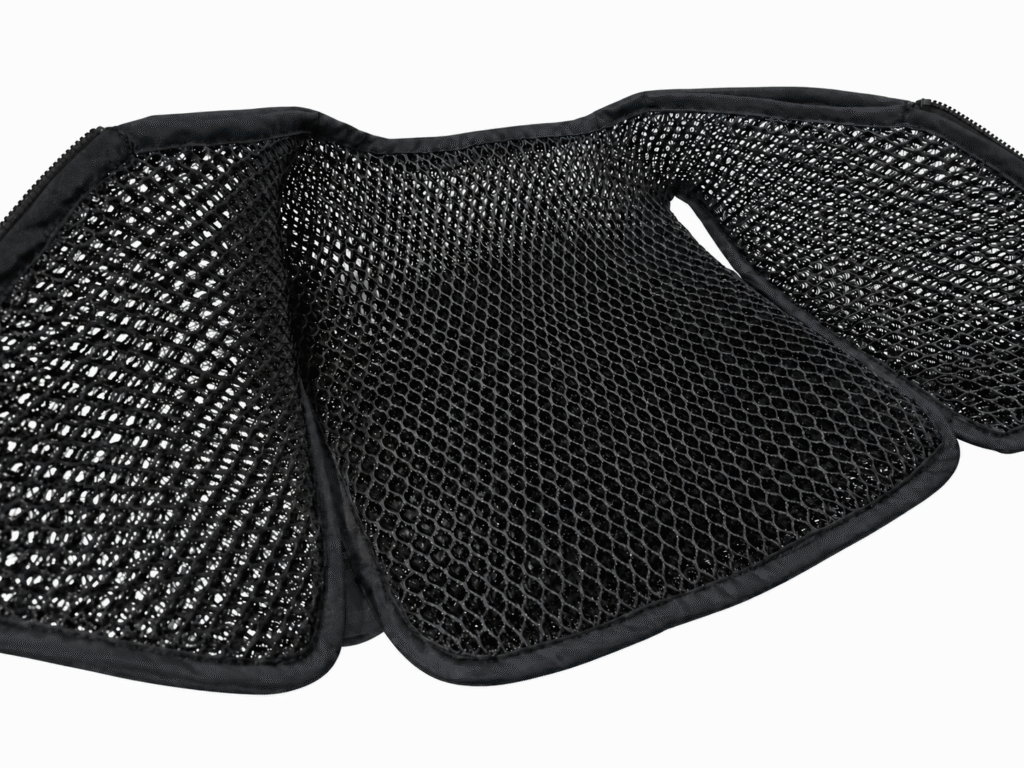
Industrial workwear increasingly relies on thick 3D spacer mesh to solve a persistent mechanical challenge: maintaining an open air cavity between the body and outer gear under continuous external pressure. When workers wear heavy tool harnesses, backpacks, or fan-fitted jackets, standard flat textiles collapse, sealing off air movement and trapping body heat. Integrating a resilient spacer mesh creates a stable stand-off layer that prevents this collapse while cushioning the wearer against rigid strapping.
This guide focuses strictly on material evaluation, physical property trade-offs, and sampling protocols for product developers and sourcing teams. It does not evaluate finished-garment cooling claims or thermal ratings, as real-world cooling performance depends on overall garment design, pack placement, and operating environments.
What Role Does Spacer Mesh Play in a Workwear Cooling Vest?
In an industrial cooling vest or under-vest, 3D spacer mesh functions primarily as a structural microclimate chamber and mechanical buffer.
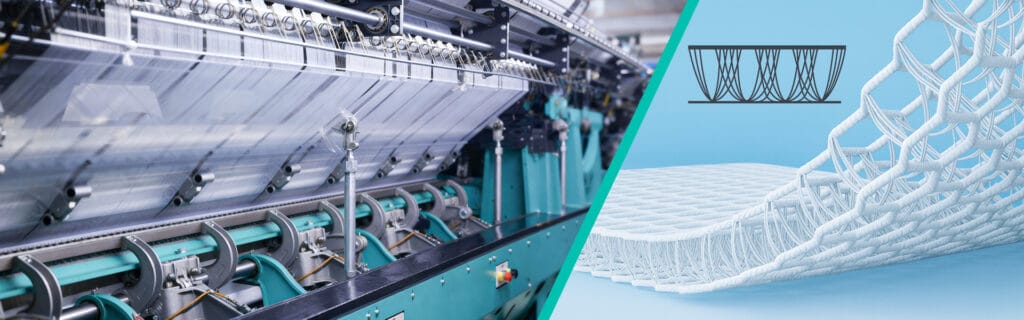
Maintaining the Air Cavity: The primary role of the monofilament core is to act as an array of microscopic pillars. Under the localized pressure of safety harnesses or tool belts, the mesh resists total compression, preserving an open space through which air can circulate.
Structural Base for Modular Cooling: These vests often integrate internal pockets or slots designed to hold ice packs, frozen gel pads, or Phase Change Material (PCM) packs. The 3D mesh provides the dimensional stability needed to hold these weighted inserts securely across the back and chest without sagging.
Contact Decoupling: By keeping the outer shell fabric off the wearer’s skin, the mesh prevents damp fabric cling and cushions pressure points created by heavy straps.
Which Fabric Properties Should Buyers Compare?


Thickness and weight
A thicker mesh may provide more separation, but it also adds material to the garment. Buyers should compare samples in the context of the proposed vest pattern, rather than selecting the thickest available option.
Ask for both thickness and fabric weight. Two meshes with similar thicknesses can feel different in the hand and produce different garment weights. A small material swatch is useful for initial screening, while a larger panel gives a better sense of how the fabric will hang and move when worn.
Behavior under pressure
For a vest that may sit beneath harness straps, the relevant question is how the mesh behaves when pressure is applied. Does it compress easily? Does it recover its shape after the pressure is removed? Do different parts of the fabric respond consistently?
These questions should be assessed with the intended garment construction in mind. A promising fabric sample does not, by itself, establish how much air space a completed vest will retain during use.
Air permeability and surface structure
Open mesh surfaces can support airflow, but appearance alone is not enough to compare fabrics. The size and arrangement of the openings, the spacer yarn structure, and any additional layers can all affect the result.
Flexibility and contact feel
The vest must also move with the wearer. Compare how each mesh bends around the shoulders, chest, and sides, and check the feel of the surface that may face the body or an inner garment. A fabric that feels suitably supportive in a flat sample may feel too stiff once it is folded into an edge or seam.
Appearance after care and handling
Handling, folding, and washing may affect the appearance of a mesh. Any care requirements for the final vest should be agreed with the garment manufacturer and checked on the assembled sample.
Why Does Thick Spacer Mesh Need a Sewing Trial?
A mesh can look suitable as a roll of fabric and still be difficult to turn into a vest. Thick, open constructions deserve particular attention at cut edges and joining points.
Make Small Trials Covering
- Cut edges: Does the mesh hold its shape after cutting, and how should exposed edges be handled?
- Binding: Can the chosen binding cover the full edge neatly without excessive bulk or distortion?
- Seams: Do stitched areas remain flexible and comfortable where panels meet?
- Attachments: How will the zipper, side adjusters, and pocket openings be secured to the mesh?
- Consistency: Can the same result be repeated across multiple trial pieces?
The answers depend on both the fabric and the factory’s equipment and methods. For that reason, a fabric supplier can help identify material options, but the proposed garment factory should verify the cutting, sewing, and finishing process.
What Should You Send a Spacer Mesh Supplier?
You do not need a finalized fabric specification to start a useful discussion. A supplier can respond more effectively when you share the design problem and the material’s intended position in the vest.
A helpful inquiry includes:
- Photos, drawings, or a physical reference sample
- The panels in which spacer mesh will be used
- Preferred composition, thickness range, and hand feel
- Any weight or flexibility concerns
- Planned edge binding, seams, zipper, and adjuster details
- Whether the vest will include pockets for removable ice packs
- Target market, estimated order quantity, and sampling schedule
If you already have a garment factory, involve them early. Their feedback on cutting and sewing can help narrow the material choices before a full vest sample is made.
Extended Reading: Structural Air Cavities vs. Evaporative Moisture Management
While industrial workwear relies on thick 3D spacer mesh primarily for load-bearing stand-off channels and edge-finishing stability, 3D spacer structures play distinctly different functional roles across temperature-regulating gear.
In passive, water-activated systems—such as our upgraded dog cooling vest fabrics—the spacer layer is engineered with entirely different priorities: minimizing wet weight gain, maximizing water vapor permeability, and preventing damp fabric cling against sensitive animal coats. Exploring how spacer geometry is tailored for evaporative systems provides valuable insight into the diverse physical mechanics of functional knitwear.
For an example of that different approach, read our dog cooling vest fabric design article.
Discuss Your Workwear Cooling Vest Material Requirements
If you are developing a workwear cooling vest, send us your reference images or sample, proposed construction, and the properties you need from the mesh. We can help you compare 3D spacer mesh options for your material trials and work with your garment manufacturer’s feedback as the design develops.
Is thicker 3D spacer mesh always better for a cooling vest?
No. While an 8 mm or 9 mm mesh provides a larger physical air cavity and higher compression resistance under heavy tool belts, it also increases overall garment bulk, adds weight, and creates challenges during curved edge binding. For light-duty tasks or garments worn under standard clothing, a 5 mm to 6 mm construction often delivers the ideal balance between breathability, flexibility, and easy sewing execution.
Is 100% polyester the only viable composition for this application?
Polyester is standard for industrial spacer mesh because its monofilaments offer high mechanical spring-back, excellent hydrolytic stability, and zero water retention—ensuring the vest does not absorb sweat and become heavy. While nylon can offer a softer feel, it absorbs more ambient moisture and tends to soften under humid conditions, reducing its compression resistance when the wearer sweats heavily.
Why must edge binding and sewing trials be completed before confirming bulk fabric orders?
A spacer mesh swatch may meet all mechanical and aesthetic requirements on paper, but its production viability depends on how cleanly it handles cutting and edge wrapping. Without a sewing trial, brands risk discovering post-purchase that the monofilaments fray aggressively, that standard binders cannot feed the compressed bulk, or that finished seams create uncomfortable pressure points against the body.